
What is a virtual CFO? It’s an experienced finance professional who works with your business part-time and remotely. They handle cash flow forecasting, budgeting, MIS reporting and financial strategy, while your CA or accountant keeps filing the returns.
Here’s a simple way to see it. Your books tell you what happened last month. A virtual CFO helps you decide what to do next month. That gap is what many growing businesses feel when a question like “Can we afford this hire?” or “Should we take this loan?” can’t be answered from the bank balance alone.
In this guide, we’ll look at what a virtual CFO does, how the role is different from an accountant, what services you get, what it costs in India, and when it makes sense to hire one.
Quick takeaway: If your books are in order but you still can’t predict your cash, a virtual CFO is probably the missing piece. If you only need filings done, a good CA is enough.
Table of Contents
What Is a Virtual CFO? Meaning and Full Form
The vCFO full form is Virtual Chief Financial Officer. “Virtual” is about how the work gets done: cloud accounting software, dashboards, and scheduled calls. It says nothing about skill level.
You’ll also see part-time CFO, outsourced CFO, CFO as a service, and fractional CFO. They overlap a lot, so check the deliverables, not the label. Growing businesses can benefit from V Lead’s virtual CFO services to manage cash flow, plan finances, and make better business decisions.
What Does a Virtual CFO Do? Responsibilities and Core Services
The work changes with your size, but these six areas stay the same.
Financial Planning and Analysis (FP&A) and Budgeting
This means building a yearly budget and checking it against real numbers every month. A vCFO runs variance analysis: where did you overspend, where did sales fall short, and why? They also run “what if” scenarios, like “What if our biggest customer pays 30 days late?”
Cash Flow Forecasting and Working Capital Management
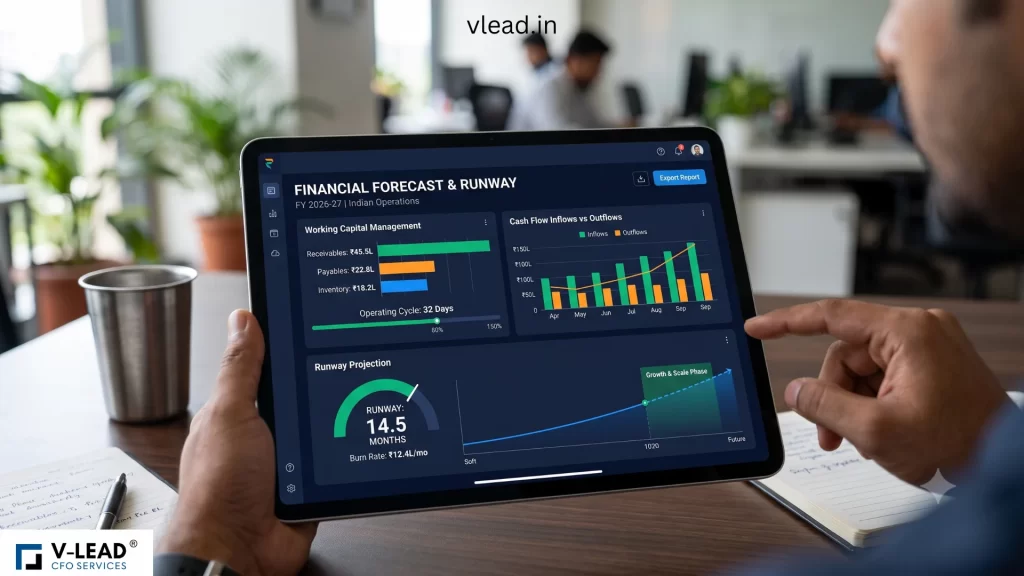
Profit and cash are not the same thing. A business can show a profit and still run out of money. A vCFO builds a rolling cash flow forecast and tracks receivables, payables, and inventory. The aim is simple: see a cash gap weeks before it arrives, not on the day salaries are due.
MIS Reporting and KPI Dashboards
A useful monthly MIS pack has:
- Profit and loss against budget.
- Balance sheet and cash flow statement.
- Receivables and payables ageing.
- Margins by product or customer, ABC analysis
- Segment wise profitability
- A short note on what changed and why.
It should be short enough for a founder to read in one sitting, and it should land on a fixed date every month. If your accountant dont close the books on time or you can’t trust them, that’s usually the first thing a vCFO fixes.
Fundraising Support, Financial Modelling and Due Diligence
A vCFO builds the financial model, prepares projections and organises the data room, so investor questions get answered from one consistent set of numbers. For banks, they prepare CMA data and working capital proposals.
Internal Controls and Financial Governance
This covers approval limits, regular reconciliations, separation of duties, and fraud-risk checks. The vCFO also works with your statutory auditors so audit queries stay manageable through the year.
Strategic Finance and Decision Support
This is the work that separates a vCFO from an accountant. They help founders answer questions like:
- Can we afford to expand or hire?
- Raise a Debt or Equity?
- Which products or customers hurt our margins?
- How much cash will we need next year?
One limit matters here. Your CA or accountant still files GST, TDS, and ROC returns unless your agreement says otherwise. The vCFO oversees compliance. They don’t prepare or file it.
What you actually gain: earlier warning on cash gaps, reports you can trust on time, a clear view of your real margins, and less of your own time spent chasing numbers its more of business consulting than following a compliance calendar.
What Is the Difference Between an Accountant, Virtual CFO, and a Full-Time CFO?
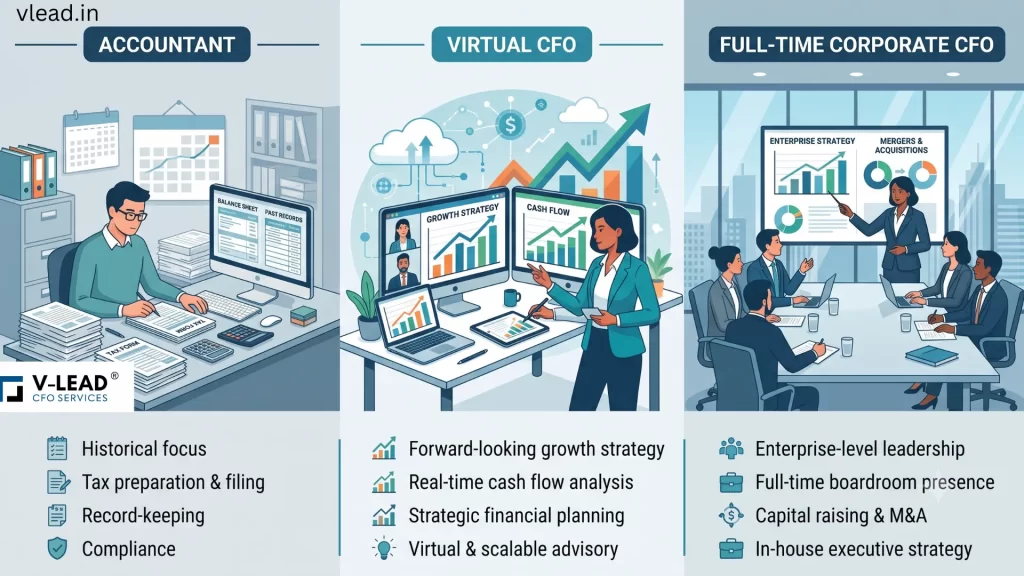
Criteria | Accountant | Virtual CFO | Full-time CFO |
Main question | What happened? | Why did it happen, and what next? | Where is the whole business headed? |
Focus | Books, GST, TDS, returns | Cash, profit, planning, funding | All of finance, plus the finance team |
Time view | Past | Future | Past and future |
How they work | Periodic | Part-time, mostly remote | Full-time, on your payroll |
How you pay | Per task or monthly fee | Monthly retainer | Salary plus all employees benefits |
Best for | Every business | Growing SMEs and startups | Larger or more complex businesses |
Simple rule: keep your accountant while the books are the only problem. Add a virtual CFO when the decisions get harder. Think about a full-time CFO when finance needs its own team inside the company.
What Are Virtual CFO Services in India?
Virtual CFO services are finance leadership delivered on a monthly retainer. In India, they usually include a monthly review call, an MIS pack, a cash forecast, budget tracking, and a quarterly strategy review. This is outsourced finance at the leadership level, not the data-entry level.
Scope is where most people get confused, so here is a simple way to think about it.
Level | Suits | What you get | Rhythm | Usually not included |
Basic | Small team, simple books | MIS review, cash view, compliance tracker | Monthly call | Filings, bookkeeping, funding work |
Mid | Growing SME or startup | Basic, plus budget, 12-month cash forecast, KPI dashboard, bank or investor data | Monthly call, quarterly strategy review | Return filing, audit sign-off |
Senior | Funding, multiple entities, cross-border work | Mid, plus financial model, due diligence support, board or investor reporting, controls review | Weekly check-ins, monthly and quarterly reviews | Legal advice, guaranteed funding |
From Sudha Ramakrishnan, founder of V-Lead: “Founders often ask me: ‘I’m making a profit, so why is my bank balance so low?’ Usually the books are fine. The gap is that nobody has connected cash, compliance, and funding in one clear picture. That’s the job of a virtual CFO. Once the numbers make sense, decisions like hiring, borrowing or expanding stop feeling like guessing and start feeling like plans.”
How Does a Virtual CFO Handle the 2026-27 Tax Transition?
The Income-tax Act, 2025 came into force on 1 April 2026 and replaced the 1961 Act. Income up to 31 March 2026 (FY 2025-26, AY 2026-27) is still filed on old-Act forms. Income from 1 April 2026 falls under the new Act as Tax Year 2026-27. The Income Tax Department’s official FAQ explains how “tax year” replaces “previous year”.
A vCFO lines up your FY 2025-26 and Tax Year 2026-27 numbers, plans cash for each advance tax instalment, and checks that your compliance tracker uses the right Act for each period. Your CA files and confirms which rules apply to you. The vCFO makes sure the cash is there.
How Does a Virtual CFO Manage MSME Payments in a Cash Flow Forecast?
Under Section 15 of the MSMED Act, 2006, you must pay a micro or small supplier within the agreed period. With no written agreement, that’s 15 days. With one, it can be up to 45 days and never more. In a Rajya Sabha reply on 21 July 2026 (Unstarred Question No. 242), the Finance Ministry said that if you pay after the limit, the tax deduction comes only when you actually pay. Your CA will confirm the exact section under the new Act. You can check a supplier’s status on the Udyam portal.
Here’s how a monthly cash forecast might look. These numbers are made up for illustration, and they assume all the cash movements fall in the same month.
₹ lakh | Base case | If customers pay late |
Opening cash | 12 | 12 |
Collections from customers | 40 | 30 |
Supplier payments | (30) | (30) |
Payroll | (8) | (8) |
GST and TDS | (6) | (6) |
Advance tax (instalment month) | (5) | (5) |
Closing cash | 3 | (7) |
In the second column, ₹10 lakh of collections slips into next month, and the business ends up ₹7 lakh short. That doesn’t mean the bank will cover it. A shortfall is a shortfall until you’ve arranged the funding.
So what does the vCFO do with this? If the forecast shows this two or three weeks early, you have options:
- Chase the three biggest overdue invoices and pull in part of that ₹10 lakh sooner.
- Move a non-urgent payment by a couple of weeks. Never make an MSME supplier payment that’s close to its limit.
- Line up a short-term working capital limit with your bank before you need it.
If you only spot the gap on salary day, none of these are available. That’s the whole point of forecasting.
Who Needs a Virtual CFO? Businesses That Benefit Most
- Startups: Burn rate, runway, unit economics and investor reporting. The Commerce Ministry said there were over 2.23 lakh DPIIT-recognised startups as of 31 March 2026, with a record 55,200 added in FY26. Many need financial leadership long before they can afford a full-time CFO.
- SMEs: Sales grow, but working capital and margins get harder to manage.
- Family businesses: They need proper management reporting and financial governance as they grow.
- Indian arms of foreign companies: Group reporting, intercompany transactions, FEMA and transfer pricing all have to line up. Setting up in India? Our India entry services cover the finance side from day one.
A quick self-check. You may need one if:
- Revenue grows, but cash is hard to predict.
- The founder makes every money decision.
- Reports come late.
- You don’t know your real margins.
- Banks or investors ask for projections you can’t give.
- Your accountant records numbers but gives no advice.
If three or more fit, look into it. This is a practical guide, not a rule. Complexity matters more than turnover, so be careful with any fixed revenue cut-off. Not sure where you stand? Talk to V Lead’s virtual CFO team and go through these six points together.
When Is a Virtual CFO Not the Right Fit?
A vCFO may not help yet if:
- Your books aren’t maintained at all. Fix bookkeeping first.
- You only want filings done. That is a CA’s, Accountants job.
- You expect guaranteed funding or growth. Both depend on factors outside a vCFO’s control.
- You won’t share data or act on the advice.
- Your group is big enough to need a full-time CFO inside the company.
How Much Does a Virtual CFO Cost in India?
There’s no government-prescribed fee for vCFO services, so the numbers online come mostly from provider websites. Take them as a rough guide. RegisterKaro’s 2026 guide puts typical monthly retainers at ₹50,000 to ₹2,50,000 or more, and ₹3,00,000+ for complex strategic work. PKC India quotes ₹30,000 to ₹1,50,000 a month. They don’t agree, and that’s the point. Fees depend on:
- Business size and number of entities.
- Transaction volume.
- Reporting needs.
- Fundraising or banking work.
- Cross-border work.
- Industry and financial complexity.
- Frequency of meetings and ongoing support.
- Compliance coordination and audit support.
There’s no standard “vCFO salary”, since a vCFO earns through retainers. The better comparison is a full-time CFO, which one provider guide puts at roughly ₹40 lakh to ₹1.5 crore or more a year.
Is it worth the fee? Don’t look for a guaranteed return. Track how early you see cash gaps, whether reports arrive on time, how many days your customers take to pay, and whether you know your margin by product. If these aren’t improving after a few months, ask why.
How to Choose a Virtual CFO in India?
Ask these before you sign with a vCFO in India:
- What will I get every month? Get the deliverables in writing.
- Who does the work? The senior person or a junior?
- What stays with my accountant? And what is out of scope?
- What experience do you have in my sector? A CA or CMA qualification helps, but it isn’t proof of skill. You can check a CA’s membership on the ICAI website.
- How do you protect my data? Look for a confidentiality agreement and limited access.
- Does the accounting software keep an audit trail? If you run a company, your accounting software must record an edit log of every change. Rule 3(1) of the Companies (Accounts) Rules, 2014 applies this for financial years starting on or after 1 April 2023. You’ll find the notice on the Ministry of Corporate Affairs website.
- How will we measure success? Agree KPIs up front.
Be careful with any provider who promises guaranteed funding or won’t put the scope in writing.
What Happens in the First 90 Days of Hiring a Virtual CFO?
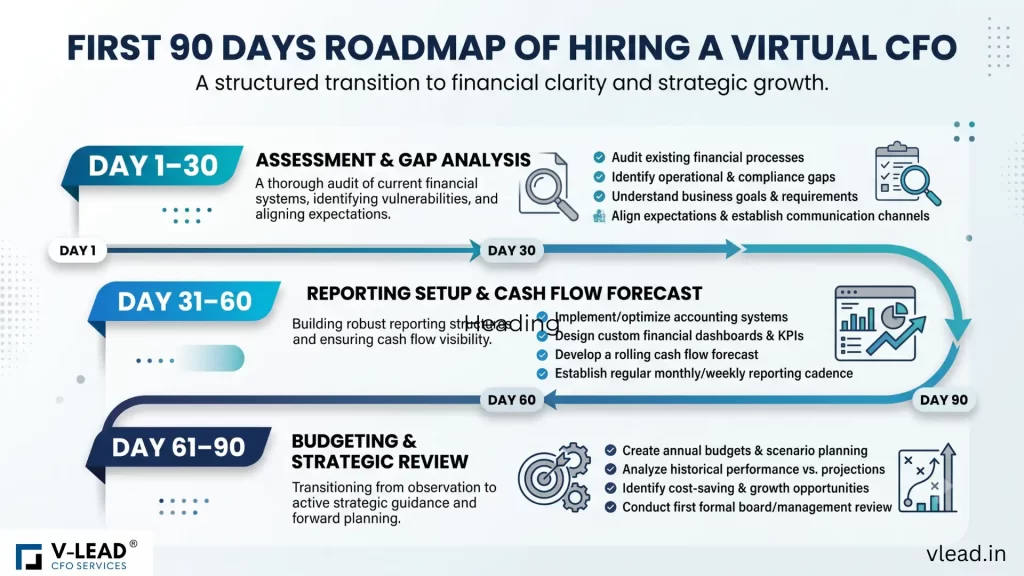
- Days 1 to 30: The vCFO learns the business, reviews your records, and lists the gaps.
- Days 31 to 60: Reporting gets set up, and the first cash forecast goes live.
- Days 61 to 90: Budget and KPIs are agreed, and the first quarterly review happens.
To speed this up, keep ready your last two or three years’ financials, bank statements, GST returns, receivables and payables ageing, loan sanction letters, a payroll summary and, for startups, your cap table.
So, Do You Need a Virtual CFO?
Here’s a simple way to decide. If your books are fine and you just need filings, stay with your CA. If cash is unpredictable and big decisions are getting harder, a virtual CFO is a good fit. If you have a large group with a finance team to lead, think about a full-time CFO.
Not sure which one you? V Lead’s virtual CFO team can look at your current setup, your reporting, and your cash gaps, and tell you which level of support fits. Book a free consultation.
FAQs
When should a startup hire a vCFO?
Is a virtual CFO worth it for a small business?
Can a virtual CFO file my GST and tax returns?
Can a virtual CFO work with my existing accountants team ?
Can I still retain my existing CA/Auditors while I opt to avail services of vCFO since I have been with them since my inception ?
Is it worth paying for vCFO Fees or hire a senior accountant or CFO ?
Disclaimer: This article is for general information. It is not professional advice. Scope and fees differ from one engagement to another, so take advice from a qualified professional before you act.